
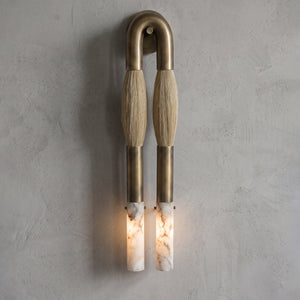
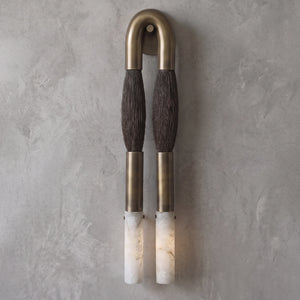
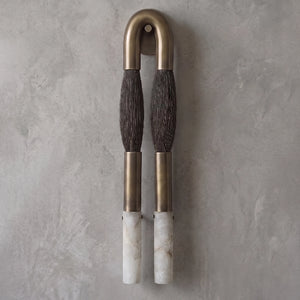
Home Sorrel Horsehair & Alabaster Wall Sconce
-15%New
Regular price $1,080.00 USD Sale price $920.00 USD
SKU: HL-WL-2609072-1

Free shipping and customs duties for US customers

Embark on a journey of light and shadow in 2026 — Up to 20% OFF.
Infuse your life with warm light.

10%

All Lighting

Copied!

15%

Spend $2000 Save

Copied!

20%

Spend $5000 Save

Copied!
Size: ∅ 5.5″ x W 3.5"x H 29.9"
Colo: Aged Brass + White
Add to Wishlist Add to Compare
Guaranteed Safe Checkout
Description

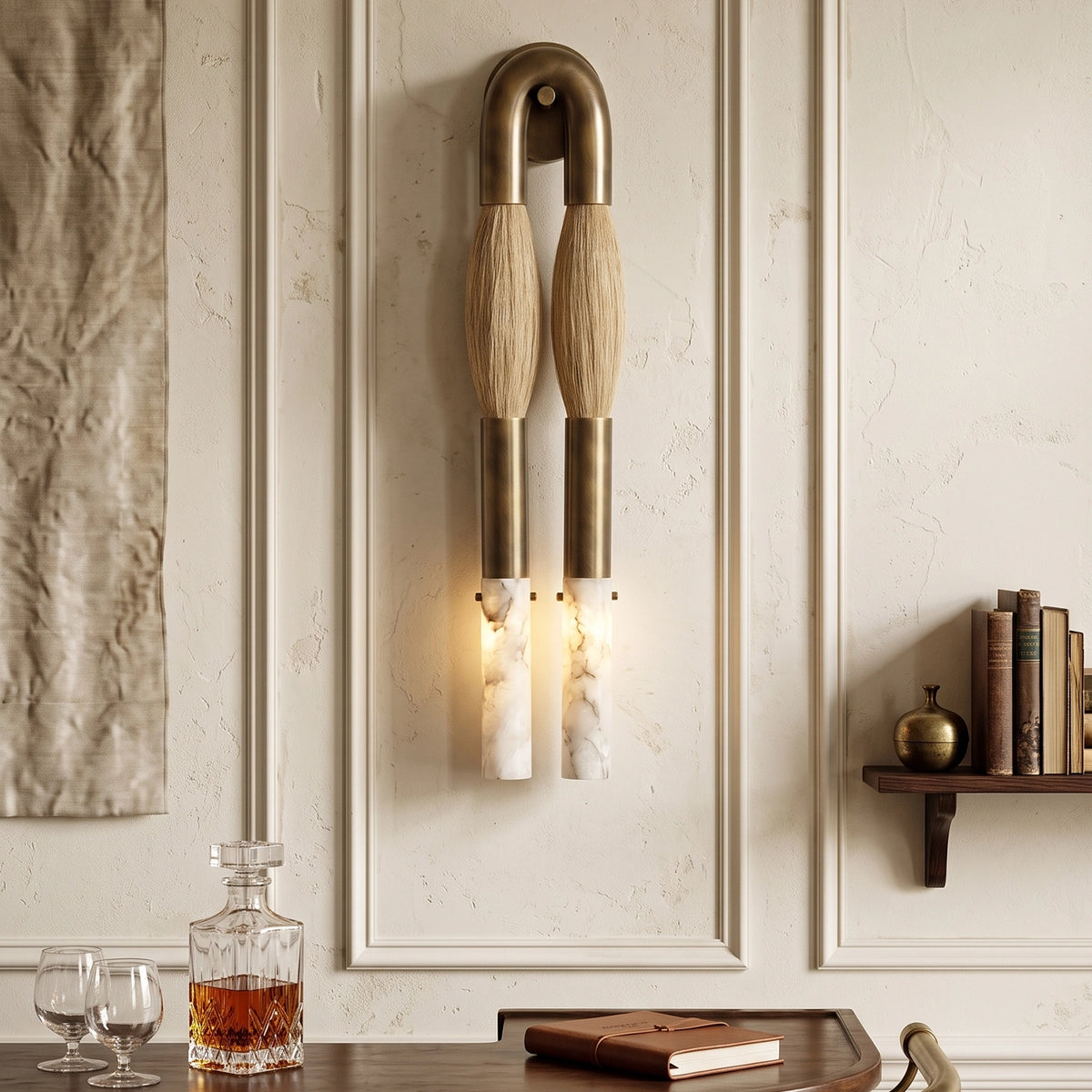
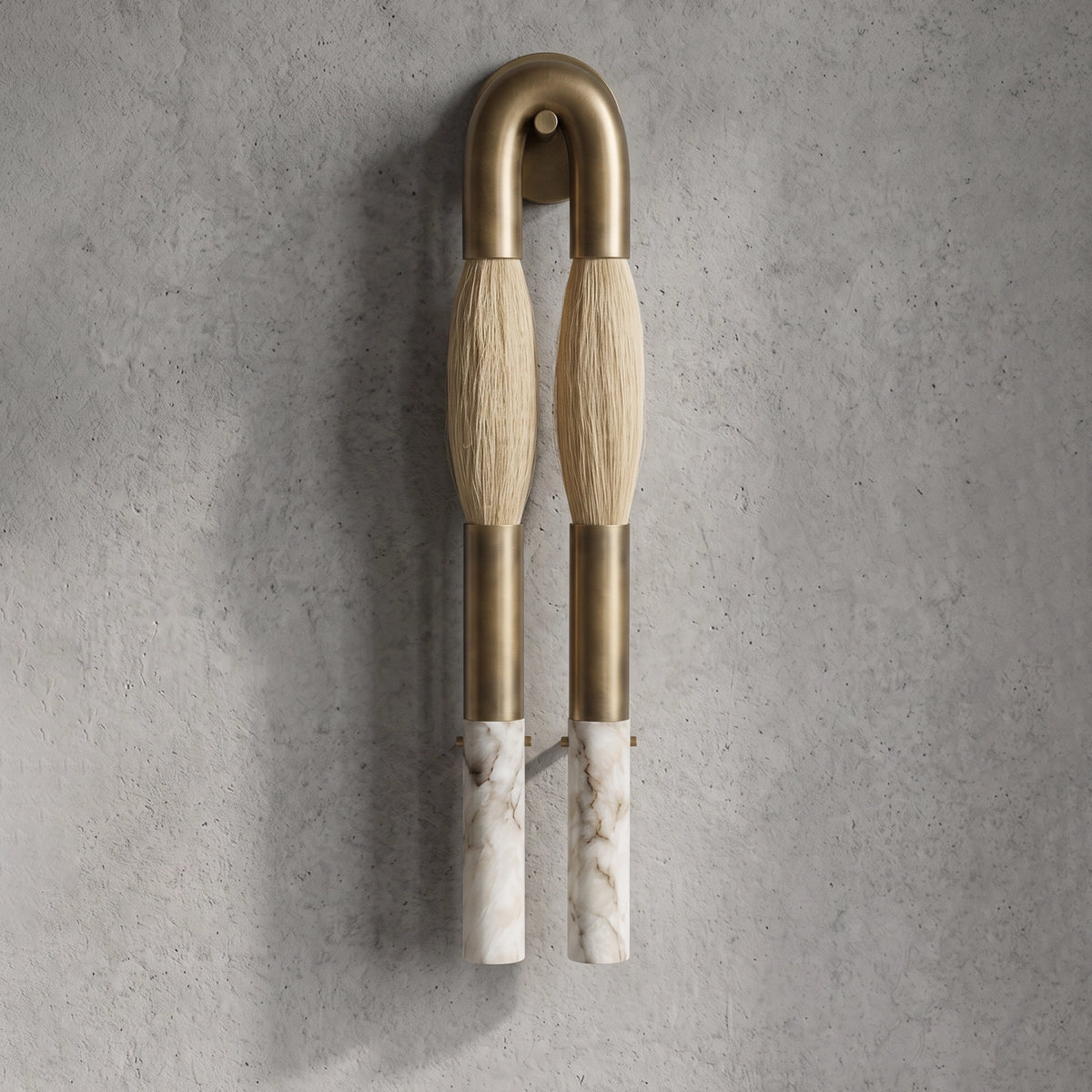
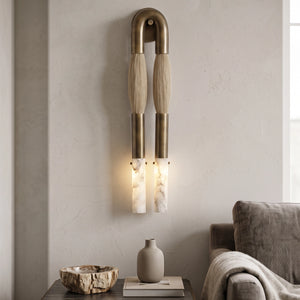
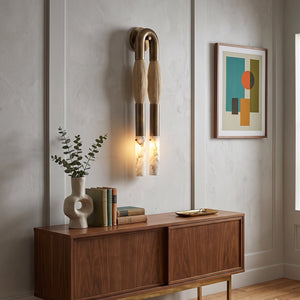
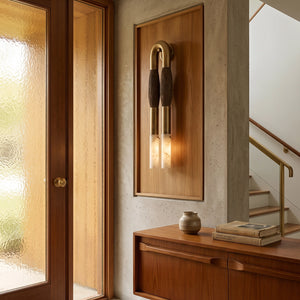
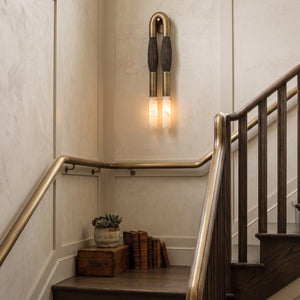
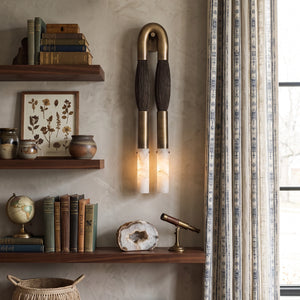
The Sorrel Horsehair & Alabaster Wall Sconce is built from three materials that were never manufactured — only shaped. A tube of solid brass rises from the wall plate and bends over in a full half-circle; below the turn, each leg gives way to a length of natural horsehair gathered in brass ferrules; and at the bottom, the light comes through a cylinder of hand-cut alabaster. Hard, soft, then stone. Nothing in the sequence is plastic, printed or moulded.

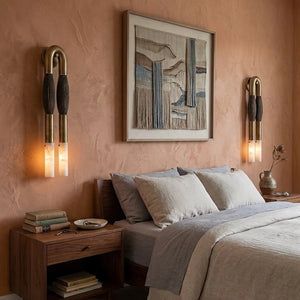
Alabaster is what separates this from an ordinary sconce. Light travels through the stone rather than bouncing off a diffuser, so the veining shows from within and the glow carries the warmth of the material itself — no bright spot, no visible source, and a different pattern on every fixture because each cylinder is cut from its own block. The horsehair above is equally singular: each strand takes light at its own angle, so a bundle reads as one soft mass from across a room and as thousands of separate fibres up close. Choose ivory for a pale, sunlit look or dark brown for depth against a light wall. A natural material wall sconce for a hallway, a bedside, a stairwell, or either side of a dressing mirror.


×2
Buy as a Pair & Save
Sconces almost always go up in twos. Select the option marked (×2) above — a set is priced below two singles, and both are cut from the same glass batch, so the tint matches exactly. Ordering separately risks a visible difference between the two.

Natural Stone Variation
Alabaster patterns vary from piece to piece — the stone you receive will differ from the one pictured. Each piece with natural textures is unique.


Why This One

Metal, Hair, Then Stone

 
01

Light Through Stone, Not Past It

A diffuser sits in front of a bulb and softens it. Alabaster does something else entirely — light enters the stone, travels within it, and comes out carrying the colour of the material. The veining shows from inside rather than on the surface, and there is no bright patch anywhere on the cylinder because the source is never behind a thin skin.

 
02

Three Materials, None Manufactured

Solid brass at the top where the weight is carried, natural horsehair through the middle where the eye lands, hand-cut alabaster at the bottom where the light comes out. Every one of them was shaped rather than made — nothing here is moulded, printed or extruded, which is why no two fixtures leave the workshop identical.

 
03

No Two Bundles Are Alike

Each strand of horsehair takes light at its own angle, so a bundle reads as one soft mass from across a room and as thousands of separate fibres up close. Thickness, sheen and the way stray hairs sit all vary from length to length. The sconce you receive will not match the photograph fibre for fibre — that is the material, not a fault in it.

 
04

Two Sources, Two Columns

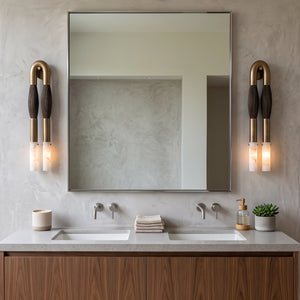
Each leg carries its own socket behind its own stone, so the light arrives as two glowing columns rather than one bright patch. Beside a mirror that difference matters — light from two points fills in the shadow under the chin that a single sconce always leaves behind.

Solid brass, natural horsehair and hand-cut alabaster — two G9 bases, max 10W each, bulbs sold separately


Specifications

Features & Details

 
Features
Material Solid Brass · Genuine Horsehair · Hand-Cut Natural Alabaster
Metal Finish Aged brass — hand-finished, with fine surface marks left visible
Horsehair Ivory · Dark brown — natural fibre, so thickness and sheen vary from piece to piece
Alabaster Cut from natural blocks — veining and translucency differ on every fixture
Form Single arched tube dropping into two legs — brass, horsehair and alabaster in sequence
Overall Size W 5.5″ × D 3.5″ × H 29.9″
Light Source Two G9 bases, one in each leg — LED or Edison, bulbs sold separately
Power Max 10W per bulb · 20W total — 3000K warm white as standard, other temperatures on request
Mounting Wall mount — hardwired to a junction box
IP Rating IP20 · indoor dry locations only · not waterproof
Dimming Depends on the bulbs — fit dimmable G9 bulbs and a compatible wall dimmer
Style Organic modern · Sculptural contemporary · Wabi-sabi · Transitional · Modern luxe
Application Hallway · Bedside · Stairwell · Either side of a dressing mirror · Entryway · Living room accent wall (indoor only)
Specification
Voltage AC 110V–240V compatible
Installation Hardwired wall mount — professional installation by a licensed electrician recommended
Control Works with a standard wall switch — switch not included
Certification UL · CE · SAA
Warranty 2-year 

Three materials, three rules: comb the horsehair with fingers or a wide-toothed comb, downward from the top ferrule and never against the lie — and never wet it. Dust the alabaster with a dry soft cloth only; it is a soft stone that absorbs liquid and etches on contact with any cleaner. Wipe the brass dry, with no polish, which would strip an aged finish back to raw metal. Switch the power off and let the bulbs cool first — G9 bulbs run hot and sit close to the stone.

Size & Installation

Tall and Narrow, Close to the Wall

Nearly two and a half feet of drop on a footprint the width of a hand — and it projects only 3.5″, so it works in a corridor where a wider sconce would catch a shoulder.

W 5.5″  ×  D 3.5″  ×  H 29.9″
One size · hardwired · projects just 3.5″ from the wall
 

29.9″

overall drop

Two and a half feet from the top of the arch to the bottom of the stone. That length is what carries the composition — it needs a clear run of wall, not a gap between a picture and a dado rail.


3.5″

projection from the wall

Shallow enough for a hallway. US building guidance keeps anything below 80″ from projecting more than 4″ into a walkway — at 3.5″ this sits inside that, which many arm-style sconces do not.


5.5″

width

Narrow across, long down. That proportion is why it suits the strips of wall other fixtures cannot use — between two doors, beside a mirror, along a stair.

Where to Set the Junction Box

The sconce hangs below the box — measure from the top, not the bottom

5′6″ figure junction box 72–76″ box height 29.9″ drop bottom lands at 42–46″ bottom of sconce 36–40″ apart, in a pair

Drawn to scale. Figure shown for reference only and is not included.

A line drawing gives the Sorrel sconce as 5.5 inches wide, 3.5 inches deep and 29.9 inches tall.
Mounting Height This sconce hangs below its junction box rather than sitting level with it, so measure from the top. In a hallway or living room, set the box at 72–76″ from the floor and the stone lands at eye level or just below. Beside a bed, drop the box to 60–64″ so the light falls on the page while you are sitting up. Our guide below covers bedside, mirror and hallway heights in more detail.
Spacing a Pair Beside a mirror, allow 36–40″ between the two boxes — close enough that the light meets in front of your face, far enough that the arches do not crowd the frame. Along a corridor, 6–8 ft between sconces keeps the rhythm even without over-lighting the run.
Installation Hardwired to a standard junction box, and a licensed electrician is the right call. Fit two G9 bulbs, max 10W each; 3000K warm white is what ships as standard. Works with any standard wall switch — switch not included. Turn the power off at the breaker before any work begins.

One thing to check: the horsehair sits roughly a third of the way down, and the alabaster runs the lowest 8″ — around shoulder height in a narrow hallway. Leave a clear run of wall there, and avoid mounting directly beside a doorway where a coat or a bag brushes past. Natural hair recovers from a light touch; stone at that height is better kept out of the traffic altogether.

Selecting Your Stone

We Can Steer the Stone. We Cannot Copy It.

Alabaster is quarried, not manufactured. The seams in a cylinder were set down long before anyone cut it, so the piece that reaches you will differ from every photograph on this page — and the two stones on your own sconce will differ from each other.

That is not a limitation we work around. It is the reason to use stone at all.

Tell Us a Direction

•  Paler and more even
•  Stronger grey movement
•  Warmer, amber-toned
•  Matched as closely as possible across a pair

Any of these we can work toward. A specific pattern from a photograph we cannot.

Six workshop views show alabaster cut into slabs, discs, rings and cylinders, each with different veining.

Stone in our workshop, cut for several different pieces — shown for the range of the material, not the shape of this fixture.

Selection happens when the cylinders are cut, so it has to be arranged with the order. We can also photograph the actual stones before they ship.

Tell Us What You're After →

About the Horsehair

Where It Comes From, and Why

Using an animal fibre is a decision that deserves an explanation rather than a mention. Here is the whole of it — source, process, and the reason we did not simply use a synthetic.

01  Source

A Byproduct, Not a Purpose

The hair is collected from routine grooming and from the agricultural supply chain. No animal is raised or slaughtered for it — the fibre exists whether or not anyone makes something from it, and this is the same supply that has served violin bows, upholstery and brushmaking for centuries.

02  Process

Washed, Sanitised, Set

Raw hair is washed to remove oils and residue, sanitised, then combed and set into the tapered bundle you see. Nothing arrives on the frame untreated. What reaches you is a clean, stable fibre with no odour and no dressing to wear off over time.

03  Why Not Synthetic

Extruded Fibre Is Too Perfect

Synthetic strands come off a die at one diameter and one sheen, so a bundle of them reflects light as a single flat surface. Real hair varies — thicker at the root, finer at the tip, and never uniformly glossy. That variation is the entire visual effect here. A synthetic version would read as a brush; this reads as a material.

Does It Shed? A few loose strands may work free in the first weeks, the way they would from any natural-fibre brush — the bundle is clamped at both ends, so what comes away are hairs that were never seated in the ferrule. It settles. Left alone on a wall, a bundle stays as it arrived for years.
Will It Fade or Yellow? Natural hair holds its colour well indoors. The ivory will warm very slightly over many years, as most pale natural materials do; the dark brown is more stable still. Keep it out of direct sunlight and away from steam — those are the two things that shorten the life of any natural fibre.
Looking After It Comb through with your fingers or a wide-toothed comb, always downward from the top ferrule, never against the lie of the hair. Dust with a soft dry brush. Never wash, wet or spray the fibre — it takes on moisture and loses the shape it was set into.

If it matters to you either way: this is a natural animal fibre, and some people would rather not have one in their home. We would rather say that plainly than bury it in a specification table. If you like the shape but not the material, write to us — we can tell you what else in the range does something similar without it.

Ivory or Dark Brown

Two Colours, Two Different Rooms

Same brass, same stone, same light — but the fibre changes what the piece does on a wall. One dissolves into a pale room; the other draws a dark line down it.

Ivory

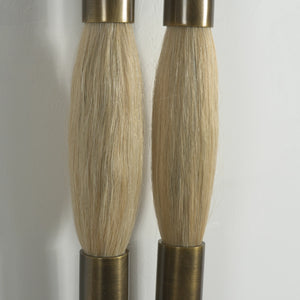
Pale strands gather into a swollen column, catching light along their whole length. Lit on a pale wall, the ivory sconce reads as one warm tone from brass to fibre to stone.

Soft, and Almost Weightless

Ivory reads as texture rather than mass. Against a limewash or plaster wall the bundle sits only a shade darker than its background, so what you notice first is the brass and the shape it makes. Lit, the whole fixture reads as one warm tone — and the pale hair sits closest of all to the colour of the alabaster below it.

Best against Pale walls
Reads as Quiet, tonal
Suits Wabi-sabi, coastal, Belgian

Dark Brown

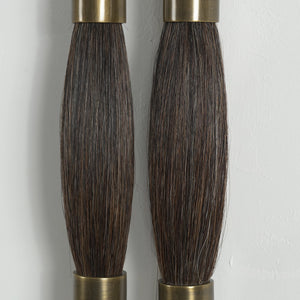
Dark strands run in bands of near-black and warm brown down the length of the bundle. Lit on the same wall, the dark sconce sets two chestnut bands above two glowing stones.

Graphic, and Full of Depth

Dark brown does the opposite — it draws two solid dark lines down a pale wall and the whole fixture reads as a silhouette. Up close the colour is not flat: strands run from near-black to warm chestnut. Lit, the contrast is sharper here than on any other version — dark fibre directly above pale glowing stone, with the brass catching the light between them.

Best against Light or mid walls
Reads as Graphic, defined
Suits Modern luxe, transitional
Match the Wall, Not the Furniture A sconce is read against the wall behind it before anything else in the room. On a pale plaster wall both work, but they do different jobs: ivory blends and lets the brass and stone lead, dark brown separates and lets the silhouette lead. On a mid-tone or coloured wall, ivory is the safer choice — dark brown can disappear into a deep green or navy rather than standing against it.
Against the Stone Worth considering on this version specifically. Alabaster is pale, so ivory hair continues it — the fixture reads as one material running from top to bottom. Dark brown breaks it, setting a dark band directly above a glowing white stone. Neither is wrong; they are two different pieces.
Either Way, It Varies Both colours are natural, undyed variation within a natural fibre — so tone shifts from bundle to bundle in both, just as it does in the stone below. Two ivory sconces on the same wall will not be an identical shade, and neither will two dark brown ones. Ordering a pair together helps, since they are made from the same batch.

Still deciding? Hold a sheet of paper against the wall where the sconce will go. If the wall reads paler than the paper, dark brown will give you contrast; if it reads darker or similar, ivory will keep the fixture from becoming a heavy patch. And if you are ordering two, order them together — matching batches is the one thing you cannot fix afterwards.

Off & On

The Stone Changes. The Hair Does Not.

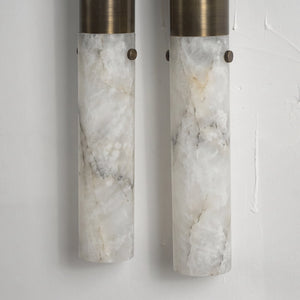
Unlit, the alabaster is a pale opaque cylinder — a piece of stone hanging on a wall. Switch it on and the veining appears from inside, because light travels through the material rather than past it.

 
Unlit against a concrete wall, the alabaster reads as a solid pale cylinder below dark fibre.

Off

Unlit — Daytime

By day this is three materials stacked rather than a light. The alabaster reads as opaque — you can see it is stone, but the veining stays close to the surface and the cylinder is simply pale. Daylight rakes across the brass and finds the hand-worked marks in it, and the fibre is at its most distinct: each strand separately visible against the wall behind.

 
With the bulbs on, seams appear inside the stone and the fibre above stays unchanged.

On

Lit — 3000K Warm White

The stone opens up. Seams that were barely visible in daylight now run through the cylinder as amber and grey lines, lit from within rather than from behind — a frosted diffuser has nothing to reveal, and this is the difference the material buys you. Above it, the fibre stays exactly as it was: the source sits below the hair, not behind it.

What Changes Only the stone — and it changes more than most materials do. Alabaster is dense enough to look solid unlit and translucent enough to glow when lit, which is a narrow band of thickness to hit and the reason the cylinders are turned by hand. You effectively own two different fixtures, one for daylight and one for after dark.
The Bulbs Two G9 bases, one behind each stone, max 10W each — bulbs sold separately. 3000K warm white ships as standard and it matters here: warm light brings the amber out of the alabaster, while anything above 4000K drains the stone toward grey and flattens the veining you paid for.
Brightness & Dimming At 10W a side this is an accent fixture — enough for a hallway wall, a bedside or the space beside a mirror, not enough to be the only light in a room. Worth fitting a dimmer: turned low, the stone stops being a light and becomes an object with something warm inside it.

Getting the colour right: with natural stone the bulb decides what you see. Warm light finds the amber in alabaster; a cool bulb makes the same cylinder look like frosted glass and takes the material with it. Our guide below covers how colour temperature changes what a material looks like.

How It's Made

Three Materials, Three Different Trades

Metalwork at the top, fibre in the middle, stonecutting at the bottom — three crafts that have nothing to do with each other, assembled into one fixture.

 
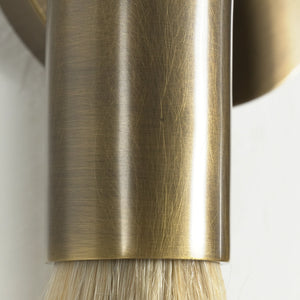
Fine tooling marks run across the aged brass ferrule where it grips the horsehair below.

The Ferrule That Holds It

Each bundle is clamped inside a brass sleeve at both ends — that is what keeps the shape and stops the hair working loose. Look at the metal in raking light and you will see fine marks across the surface: this is aged brass, hand-finished rather than plated, and those marks are the process left visible rather than polished away.

 
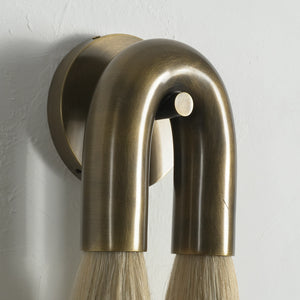
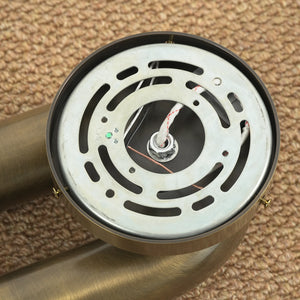
A single brass tube turns a full half-circle above a round wall plate, pinned at the centre.

One Tube, One Bend

The arch is a single length of brass bent through a half-circle, not two legs welded to a curve. A welded joint at the apex would have to be ground and refinished, and on aged brass that repair always shows. Here the tube simply turns — and a small brass pin at the centre fixes it to the wall plate behind.

 
Grey seams run through the alabaster cylinder beneath its brass collar and thumbscrew.

Stone Turned Thin Enough to Glow

Each cylinder is cut from a block of alabaster and turned down until light passes through the wall without the stone losing its body. That thickness is worked by hand and judged by eye — too thin and it goes translucent and fragile, too thick and the light never gets out. Held by the same knurled thumbscrew as the rest of the fixture, so it lifts off by hand for a bulb change.

Every Cylinder Is Different Veining, tone and translucency are decided by the block the stone came from, not by us. Two cylinders on the same fixture will not match each other exactly, and a sconce ordered next year will not match one ordered today. Lit, that variation is what you notice most — a seam that catches the light on one leg and not on the other.
Aged, Not Plated The brass is aged in the metal rather than coated over it, so the tone sits in the surface and deepens rather than chipping at an edge. Fine surface marks are part of a hand-finished piece — each sleeve and each length of tube carries its own, and no two fixtures match mark for mark.
Assembly You Can Undo Thumbscrews at the stone, a pin at the wall plate, ferrules at each end of the fibre. Nothing structural is bonded — which matters most for the part you will actually touch: changing a G9 bulb means loosening one screw by hand, not dismantling the fixture. Support the stone as it comes free; alabaster is heavier than it looks.

Living with brass, hair and stone: a dry cloth on all three. No metal polish on the brass — it strips an aged finish back toward raw metal. No water or cleaner on the alabaster, which is a soft stone that absorbs liquid and etches on contact with anything acidic. Comb the fibre downward with the lie of the hair, never against it. Switch the power off and let the bulbs cool first.

Buy the Pair

Sconces Go Up in Twos

One is a detail on a wall. Two make a composition — and with natural stone and natural fibre there is a practical reason as well: a pair ordered together is cut and gathered from the same run.

 
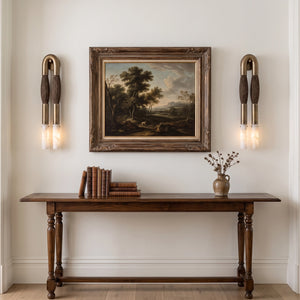
A pair flanks a console table, the stones glowing at either end of the wall above it.

01  Entryway

Either End of a Console

An entrance is where a fixture gets looked at rather than walked past, which is exactly what stone rewards. A pair brackets the console and gives the wall a vertical rhythm that a single sconce cannot — and because these project only 3.5″, they sit clear of anyone taking off a coat beneath them. Allow 36–40″ between the two junction boxes.

 
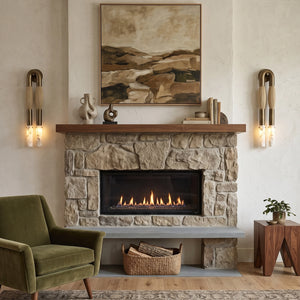
Two sconces sit either side of a fireplace, stone answering stone across the chimney breast.

02  Fireplace

Flanking a Chimney Breast

This is the placement the material was made for. A fireplace surround is usually stone or masonry already, and alabaster answers it in a lighter key — the same family of material, lit from within. Mount them level with the top of the mantel or a little above, and keep both at the same height: on a symmetrical wall an inch of difference reads immediately.

 
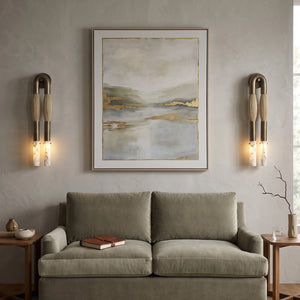
A pair above a sofa washes the wall from both ends without lighting the seat directly.

03  Living Room

Above a Sofa

Above seating, a pair does what a table lamp cannot — it lights the wall rather than the room, and leaves every surface clear. At 10W a side the output is deliberately low, so nobody sitting beneath gets light in the eyes. Set the boxes well above head height when standing, and let the sofa set the distance between them.

Order Them Together Two natural materials, both of which vary. Horsehair shifts in tone from batch to batch, and every alabaster cylinder is cut from its own block. Two ordered at the same time come from the same run and sit together; two ordered months apart may not. This is the one thing about a pair you cannot correct afterwards.
Spacing & Height Beside a mirror or a console, 36–40″ between junction boxes. Either side of a fireplace, let the chimney breast set the distance and keep both boxes at exactly the same height. Along a corridor, 6–8 ft keeps the rhythm even without over-lighting the run.
Two Boxes, One Switch Each sconce needs its own junction box, and both are usually run to a single wall switch — worth telling your electrician before the walls are closed up. Fit the same bulbs in both: two G9s at different colour temperatures will show, and on stone the mismatch is obvious because one cylinder goes amber while the other stays grey.

Before you order two: confirm both junction boxes will sit at the same height — on a pair this is more visible than on almost any other fixture, because the long drop exaggerates a difference of even an inch. Mark both positions and check them with a level before the electrician cuts.

Care

Three Materials, One Rule Between Them

Brass, hair and stone want different things — but none of them wants water. Keep everything dry and the rest is a minute with a soft cloth.

The Alabaster A dry, soft cloth, wiped down the length of the cylinder. Never water, never a damp cloth, and never any cleaner — alabaster is a soft stone that absorbs liquid and etches on contact with anything acidic, and the mark does not come out. It also scratches more easily than most people expect: no abrasive pads, and take a ring off before you handle it. Support each cylinder from below rather than pushing it sideways on its collar.
The Horsehair Run your fingers or a wide-toothed comb down through the bundle, always from the top ferrule downward, with the lie of the hair. Two or three passes twice a year is all it needs. For dust, a soft dry brush, or a hairdryer on cool held a foot back. Never wash, wet or spray it, and never brush upward — a frizzed bundle does not come back.
The Brass The same dry cloth. No metal polish — it strips an aged finish back toward raw metal and cannot be matched afterward. Work downward and keep the cloth clear of the fibre above; a cloth that brushes the hair on its way past is the most common way people get moisture where it should not be.
Where Not to Put It Rated IP20 — dry indoor spaces only, and here two materials say the same thing. Steam softens natural hair long before anything looks wrong, and alabaster absorbs moisture through its surface. That rules out any bathroom with a shower or bath in use. A dressing area or a powder room without a shower is fine. Keep it out of direct sunlight as well.

Changing a bulb: switch the power off at the wall and let the bulbs cool — G9s run hot and sit close to the stone. Loosen the knurled thumbscrew by hand and slide the alabaster cylinder down and off, supporting it as it comes free; stone is heavier than it looks and there is nothing below to catch it. Change the bulb, refit, and tighten by hand only. No tools, and nothing that requires touching the fibre above.

Questions, Answered

Horsehair & Alabaster Sconce FAQ


Where does the horsehair come from?
From routine grooming and the agricultural supply chain — no animal is raised or slaughtered for it. The fibre exists whether or not anyone makes something from it, and this is the same supply that has served violin bows, upholstery and brushmaking for centuries. Every bundle is washed to remove oils, sanitised, then combed and set before it reaches the frame; nothing arrives untreated, and there is no odour or dressing that wears off over time.
Is the alabaster real stone?
Yes — each cylinder is cut from a block of natural alabaster and turned down by hand until light passes through the wall without the stone losing its body. That is why it looks opaque by day and glows from within at night: light travels through the material rather than past a diffuser. It also means the two cylinders on your fixture will not match each other exactly, and a sconce ordered next year will not match one ordered today.
Does the horsehair shed?
A few loose strands may work free in the first weeks — those are hairs that were never seated properly in the ferrule, and the same happens with any natural-fibre brush. The bundle is clamped in a brass sleeve at both ends, so what stays is held. It settles quickly, and left alone on a wall a bundle stays as it arrived for years.
Ivory or dark brown — which should I choose?
Choose by the wall behind it, then by the stone. Ivory sits close to the colour of the alabaster below, so the fixture reads as one material running top to bottom — the gentler choice, and the safer one on a mid-tone or coloured wall. Dark brown sets a dark band directly above pale glowing stone, which is the sharper contrast of the two and reads as a silhouette from across a room. Neither is wrong; they are two different pieces.
Can it go in a bathroom?
Not one with a shower or bath in use, and here two materials say the same thing. The rating is IP20, but the real limit is what it is made of: steam softens natural hair long before anything looks wrong, and alabaster absorbs moisture through its surface — a soft stone in a wet room does not recover. A dressing area or a powder room without a shower is fine. Keep it out of direct sunlight as well.
How high should it be mounted?
This sconce hangs below its junction box rather than sitting level with it, so measure from the top. Hallway or living room: set the box at 72–76″ from the floor. Beside a bed: drop it to 60–64″ so the light lands on the page while you are sitting up. Beside a mirror or a console, allow 36–40″ between two boxes. It projects only 3.5″ from the wall, which keeps it inside the 4″ that US guidance allows for anything below 80″ in a walkway.
What bulbs does it take, and how bright is it?
Two G9 bulbs, one behind each stone, max 10W each — bulbs are not included. 3000K warm white is what we photograph with and it matters more here than on most fixtures: warm light brings the amber out of the alabaster, while anything above 4000K drains the stone toward grey and flattens the veining. At 10W a side this is an accent fixture: enough for a hallway wall, a bedside or a mirror, not enough to be the only light in a room. Changing a bulb means loosening one thumbscrew by hand and sliding the cylinder off — support it as it comes free.
How do I clean it?
Nothing wet, on any part of it. Stone: a dry soft cloth down the length of the cylinder — alabaster absorbs liquid and etches on contact with any cleaner, and it scratches more easily than people expect. Hair: fingers or a wide-toothed comb, always downward with the lie, never against it and never brushed upward. Brass: the same dry cloth, no polish, working downward and keeping clear of the fibre above. Switch the power off first. Twice a year is plenty.

Same Design, Two Materials

Still Deciding? The Only Difference Is the Bottom Section.

Identical brass arch, identical horsehair, identical size and wiring. One ends in hand-cut alabaster, the other in frosted acrylic.

Grey seams run through the alabaster cylinder beneath its brass collar.

Sorrel

You are here · Alabaster

Light passes through stone and carries its colour, with veining unique to your fixture. Choose it where people get close — a bedside, a dressing mirror, a wall you look at rather than walk past.

A brass thumbscrew holds the frosted acrylic tube to the body above it.

Mistral

Acrylic

An even glow with no pattern, lighter than stone and it will not shatter if something catches it. Choose it for a corridor — or wherever the sconce is passed rather than studied.

View the Mistral →

Shipping Made Simple

We’ve got you covered with easy and reliable shipping options

Total Delivery Time = Processing Time + Shipping Time

Processing or Handling Time :
The processing time begins from the date you place your order. It usually takes 3 to 5 Business Days (Monday to Friday) to process your order. Once we’ve processed it, we can then ship it.

Customized products: Customized lighting fixtures require additional production time. Please note that the processing of such orders may require an extra 5-12 business days, and the total estimated delivery time will be extended accordingly. 

Shipping Charge and Transit Time:
Free Standard Shipping (25-40 business days): Free for all orders.
Expedited Shipping (9-14 business days): Faster delivery is available—please read our Shipping Policy for specific fees.

Thank you for shopping with us. We understand that you want every item you purchase to perfectly suit your home. To ensure a pleasant and worry-free shopping experience, please read the following policy carefully before making your purchase.

1. Return Period and Product Condition

Our standard return policy is valid for 30 days from the date you receive your order. If more than 30 days have passed since delivery, unfortunately, we cannot offer a refund or exchange.

Important: Items that have been installed, have broken wiring, or loose crystals are not eligible for return.

All returned items must meet the following requirements:

  • Original Condition: Must be unused, unworn, and include all original tags, labels, and packaging.

  • Complete Accessories: All accessories, manuals, and included items must be intact. Items requiring assembly must be returned unassembled.

  • Proof of Purchase: You must provide a valid order number or proof of purchase.

Exceptions – Cannot Be Returned:

  • Customized, modified, or special-order items (including products marked “Custom Invoice,” “Made to Order,” or “Final Sale”).

  • Items not in their original condition or packaging (used or altered).

  • Returns caused by misunderstanding the product listing.

2. Eligible for Returns/Exchanges

Customers are entitled to a full refund or replacement in the following cases:

  1. The product is damaged due to quality issues or transportation.

  2. Any item returned to sender undelivered.

  3. Any item not delivered within 90 days.

For all eligible returns, we bear all costs and guarantee 100% return/refund or free replacement.

3. Not Eligible for Return/Exchange

Certain items are not eligible for returns or exchanges:

  1. Products that do not qualify for the 30-day return policy.

  2. Bespoke, custom, or special-ordered products.

  3. Products not in original condition or packaging.

4. Shipping Costs for Customer-Initiated Returns

If a return is initiated due to the customer’s personal reasons, the customer is responsible for the return shipping costs. The exact fee depends on the chosen courier service. Customer-related reasons include:

  • The customer feels the product does not meet their expectations;

  • The customer finds the size too small or too large;

  • The customer believes the color does not match expectations;

  • The customer wants to return the product for personal reasons (e.g., changed mind or no longer needs the item);

  • The customer ordered the wrong item or quantity;

  • The customer did not carefully read the product description and is surprised by the product’s features or specifications.

5. Return & Exchange Process

Before returning any items (within 30 days), please contact our customer service team. Returns without prior authorization will not be accepted.

Step 1: Submit Your Request
Email support@hoailamp.com with:

  • Order number

  • Item(s) to return or exchange

  • Detailed reason for return/exchange

  • Photos if there is a quality issue

Step 2: Wait for Authorization

Before sending your package, you must contact Hoailamp via email to obtain an RMA (Return Merchandise Authorization) number. Items sent without authorization may not be processed.

Email: support@hoailamp.com

Once approved, please send your package to the following return address and follow the packaging instructions carefully:

Return Address:
Recipient: Zhang Lei
Address: Building 4, No. 80 Longxi Road, Jianghai District, Jiangmen City, Guangdong Province, China
Postal Code: 529080

Step 3: Package & Ship

  • Take photos of the product and packaging before shipping to show it is in original condition.

  • Include order confirmation, all original accessories, and packaging.

  • Email us the tracking number after shipping.

Step 4: Refund or Exchange Processing

  • Refunds:

    We will refund to your payment account after returned once the refund approved. Keep in mind that it may also take some time for your bank or credit card company to process and issue your refund. 

    If you paid with a credit or debit card, we will refund your money to the same card once we receive your return. Refunds will take 5-7 business days.

    If you paid with PayPal, we will refund your money to your PayPal account once we receive your return. Refunds will take approximately 1-3 business days.

    To check the status of your refund, please visit the your Account- Orders history page.

  • Exchanges: We will process your return within 3–5 business days after receiving the returned item, and ship the replacement once the inspection is completed.

6. European Union 14-Day Cooling-Off Period

EU customers have the right to cancel or return an order within 14 days without justification. The item must be unused, with tags, and in original packaging, with proof of purchase.

7. Special Conditions

  • Order Cancellation: Within 24 hours of confirmation, free of charge.

  • Custom Items: Cannot be canceled.

  • Non-Custom Items:

    • Cancel within 24 hours of placing the order, no cost.

    • Cancel after 24 hours but before shipment, $50 handling fee.

    • Once shipped, orders cannot be canceled.

8. Contact Us

If you have any questions about returns, exchanges, or cancellations, contact our customer service team:

Hoailamp reserves the right to update or modify this policy at any time without prior notice.

We are committed to providing a safe, secure, and seamless shopping experience. Protecting your personal information and payment security is our highest priority.

1. Website Security

We take online security seriously and implement industry-standard measures to protect your data throughout your browsing and shopping experience.

Secure Encryption:
Our website uses advanced SSL/TLS encryption technology. All data transmitted between your browser and our servers—including personal information and payment details—is fully encrypted to prevent unauthorized access or interception.

Privacy Protection:
We comply with strict privacy standards and only collect the information necessary to complete your order. All customer data is handled with care and protected through secure systems.

2. Payment Security

We use Shopify Payments to process all transactions securely and reliably. Every payment is protected by industry-leading security standards to ensure a safe checkout experience.

Accepted Payment Methods:
Visa, Mastercard, American Express, Diners Club, Discover, Shop Pay, and JCB.

Shopify Payments Security:
All payments are processed through Shopify Payments, a PCI DSS Level 1 compliant platform. It uses advanced encryption and fraud detection technologies to safeguard your payment information. Built on Shopify’s trusted infrastructure, it ensures every transaction is fast, secure, and reliable.

Important Note:
We do not store or have access to your credit or debit card information. All payment details are securely processed and encrypted by Shopify Payments throughout the entire transaction process.

3. Our Commitment

We are dedicated to providing a secure and worry-free shopping experience. If you have any questions regarding payment security or data protection, please contact our customer support team:

support@hoailamp.com

We are always here to help.

Sorrel Horsehair & Alabaster Wall Sconce

Sorrel Horsehair & Alabaster Wall Sconce

FAQS

Looking to make your lighting truly one-of-a-kind?

You can customize the size, color, and material of many of our fixtures! Explore all the possibilities and start designing your perfect piece on our Customization Page.

Have questions or specific requests? Our team is happy to help: Email: support@hoailamp.com

Wondering if this light works with your local voltage? The U.S. standard is 110–120V, and Europe uses 120–240V. We can also customize the voltage to fit your needs. For more details on global voltage standards, check out our Global Voltage Reference Guide.

Yes, all of our lighting fixtures are certified to meet the safety and compliance standards of the regions they are shipped to, including SAA/CE Certifications and UL certifications. For more details on our certifications, visit our Certification Page.

Please be aware that all prices shown on our website do not include duties, local taxes, or any other import charges. In most cases, our parcels pass through customs without VAT being charged. However, for larger orders or certain circumstances, we may need to provide additional information to customs and cooperate with the buyer to supply the required paperwork.

Each destination country has its own import tax threshold, which determines the value of goods that can be imported before import duties are charged. Import duties, taxes, and other charges are not included in the item price or shipping cost. These charges are the buyer’s responsibility, and we are not liable for any delays caused by customs authorities in your country.

For more details regarding applicable fees, we recommend contacting your local customs office.

Many of our fixtures are compatible with dimmer switches. Please check the product description or contact us to confirm dimming compatibility before purchase.

Natural Alabaster Lighting Fixtures

Luxurious Brass, Horsehair & Alabaster Wall Sconce.

Artisanal Craftsmanship: Natural Textures Meets Elegant Linearity.

Meticulously crafted from antique brass, natural horsehair, and translucent alabaster, this unique wall sconce showcases an unmatched blend of tactile warmth and modern elegance. The rich texture of hand-selected horsehair pairs seamlessly with the organic veining of natural stone and the refined luster of polished brass. When illuminated, light diffuses softly through the alabaster cylinder, casting an inviting, sophisticated glow that highlights every natural detail—perfectly balancing rustic organic beauty with understated luxury for high-end interiors.

Unique Architectural Design Balancing Aesthetics & Functionality
Brushed Antique Brass Finish with Vintage Tactile Charm
Selected High-Quality Horsehair with Soft & Flexible Texture
Premium Natural Alabaster Stone with Unique Veins

Why Choose Our High-Quality Materials?

Quality determines everything; we use only the finest materials.
Premium Selection
Our High-Quality Materials

Our High-Quality Materials

Premium Natural Alabaster: Hand-selected natural stone blocks featuring unique, random translucent veining; heavy, durable, and naturally cool to the touch.

High-Quality Solid Brass: Solid brass components with a rich brushed finish; substantial in weight, highly resistant to corrosion, rust, and tarnishing over time.

Ordinary Materials

Ordinary Materials

Artificial Alabaster: Synthetic resin or acrylic plates with repetitive, unnatural patterns; lightweight, prone to yellowing, chipping, and heat discoloration.

Standard Stainless Steel: Basic stainless steel or iron tubing; lighter feel, prone to surface oxidation, rusting, and finish degradation under daily use.

VS

100% Natural Materials

Premium Materials: Eco-friendly and Healthy.

Exquisite Craftsmanship

The perfect fusion of craftsmanship and modernity.

Durable and Long-lasting

Specially treated for a long service life.

Unique Aesthetic

Unique Natural Textures.

Manufacturing

From Raw Stone to Work of Art — Every Step Is a Pursuit of Perfection
Alabaster MiningOur High-Quality Materials
1

Alabaster MiningOur High-Quality Materials

Cutting and FormingCut manually or mechanically.
2

Cutting and FormingCut manually or mechanically.

Meticulous PolishingShowcases natural texture and luster.
3

Meticulous PolishingShowcases natural texture and luster.

Quality Inspection and InstallationStrict Quality Inspection and Assembly.
4

Quality Inspection and InstallationStrict Quality Inspection and Assembly.

Recently viewed products

FREE SHIPPING

Free Shipping for all orders

SUPPORT 24/7

Contact us 24 hours a day, 7 days a week

30 DAYS RETURN

Simply return it within 30 days for an exchange.

100% PAYMENT SECURE

We ensure secure payment with PEV